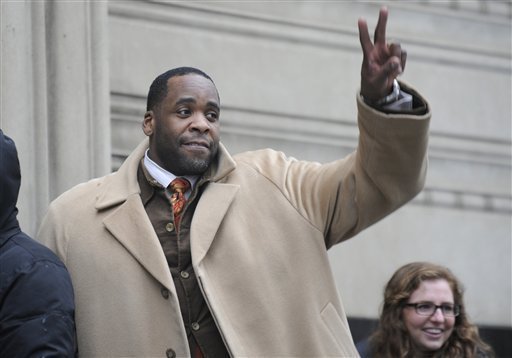
DETROIT. Former Detroit mayor, federal inmate, and philanderer-in-general, Kwame Kilpatrick, has officially entered his bid for mayor in the upcoming 2029 election, which he is already calling "The Comeback Season" on social media.
"If redemption is real, then so is my candidacy," he said, speaking before a modest crowd outside the Coleman A. Young Municipal Center on Sunday afternoon.
Flanked by several local pastors, wife Carlita Kilpatrick, and a sound system rented from a pawn shop, Kilpatrick appeared energized, confident, and unbothered by the 24 felony convictions that once derailed his career.
"Prison taught me a lot," Kilpatrick said. "Like how to lead from the inside, how to forgive the justice system, and how to properly fill out a resume without lying."
The announcement landed on Mayor Mary Sheffield the way most unexpected things do: while she was doing something extremely mayoral and completely unglamorous. She had just returned from a ribbon-cutting at a repaved stretch of Gratiot Avenue. Four months into her first term, she had a functioning voicemail system at City Hall, a pending agreement with the water department, and absolutely no bandwidth for this.
What followed was not the measured, statesman-like response of a sitting mayor. It was something closer to a controlled collapse. Within the hour, Sheffield was at a podium outside City Hall, visibly recalibrating. "No shade," she told reporters, "but I too have made mistakes. Once drove 49 in a 35." She later tweeted "Just keeping it 💯 🔥," and by evening had posted a TikTok in which she accepted what she was calling the #FelonyEnergy challenge, disclosing, without further elaboration, that she once walked out of a Target with a full cart on a broken self-checkout receipt and "never once looked back."
Her communications director described the pivot as "authentic brand recalibration in a dynamic civic moment." Others described it as a panic spiral broadcast in real time to 40,000 followers.
By nightfall, Sheffield's office released a more formal statement: "Mayor Sheffield welcomes a spirited democratic process and looks forward to running on her record. She also respectfully requests that anyone considering a mayoral bid please wait until she has, at minimum, finished repaving Gratiot Avenue."
Kilpatrick, for his part, appeared delighted. He has that particular quality of a man who has survived federal prison and emerged somehow more confident, more charismatic, and considerably more moisturized than before he went in.
Now a self-described faith leader and reformed public servant, he spent much of his campaign kickoff underscoring the concept of "spiritual parole," calling his time in prison "a divine internship." He cited his founding of two Bible study groups, a prison-wide recycling initiative, and his work teaching a financial literacy class, titled From Restitution to Reinvestment, as proof of his "rehabilitative excellence."
"God gave me a vision," Kilpatrick said. "And that vision was Detroit. Again."
Despite objections from ethics watchdogs and people who remember things, Kilpatrick's campaign quickly gained momentum on social media, buoyed by endorsements from an eclectic roster of controversial supporters, including former New York Governor Andrew Cuomo, rapper Boosie Badazz, and the felonious dynamo herself, Martha Stewart.
"He did his time," Stewart tweeted. "Now let him cook!"
While critics have raised questions about the legality of his run, Kilpatrick insists he is fully within his rights and cites Donald Trump's 2024 conviction and subsequent successful campaign to the presidency as inspiration.
"If a felon can run for president, surely I can run this city again, especially since I still remember the Wi-Fi password at City Hall," Kilpatrick said. "And I promise not to steal any money this time."
Mayor Sheffield, reached for comment on the Wi-Fi remark, said only: "We changed it."